
How OCO Studies A Living Craft

A craft cannot be fully understood by looking at the finished object alone. Behind every handmade craft lies a body of knowledge shaped by its makers, the materials used, the places they inhabit and the histories they carry.
For Odisha Craft Odyssey (OCO), understanding traditional crafts of Odisha begins with looking beyond the object. It begins where the craft lives: in villages, workshops, homes, temples, markets and communities of the artisans. Through fieldwork, oral histories, observation, documentation and material study, OCO explores how craft knowledge is practised, transmitted and transformed across generations.
Grounded in the belief that artisans are primary knowledge-holders, OCO’s multidisciplinary craft research brings together different forms of evidence to understand a craft within its social, cultural, historical and economic contexts. The aim is not simply to record objects and techniques, but to understand the living practices that sustain them.
1. Fieldwork: Understanding Craft in Its Context
The research begins with field research. Rather than studying a craft exclusively through secondary literature, OCO researchers spend time in villages, workshops, artisan homes, markets, and other spaces where craft knowledge is practised.
Such an engagement helps researchers understand how geography, locally available materials, community relationships, cultural practices and economic factors influence what artisans create and how they approach it. It also clarifies certain factual variations if it were studied from a distance. The research on Chandua, for instance, illustrates this approach. By engaging across multiple districts and craft clusters of the traditional applique craft, one can notice the difference in practices, vocabularies and histories within a single craft tradition.

Through field research in traditional crafts, OCO seeks to understand these distinctions and the contexts that shape them. The fieldwork, thus, becomes a space for learning from the people who practise the craft itself.
2. Oral Histories: Listening to Artisans’ Stories
Much of the knowledge associated with traditional crafts of Odisha exists outside of the written records. It is passed on across generations through families, apprenticeship, repetition and memory. In such a scenario, oral histories help researchers access these experiences and understand how craft traditions have evolved over time.
Conversations with generational artisans can reveal stories of migration, changing materials, evolving techniques, and relationships with temples and communities. These accounts bring personal experiences into the study of craft history.
During the research on Chandua, artisan narratives have helped researchers investigate the history of the Da-Ra-Ji community, the movement of artisan families between Puri, Pipili and other regions, and changes in appliqué practices across generations.

However, oral histories are not treated as unquestionable historical facts. Researchers verify these accounts alongside archival records, published research and material evidence. Different accounts can be examined together, allowing areas of agreement, variation and uncertainty that might emerge.
This approach to living craft traditions recognises artisans as knowledge-holders while allowing their accounts to contribute to a wider, evidence-based understanding craft research in Odisha.
3. Observation: Understanding the Knowledge Behind the Craft
Some forms of craft knowledge are difficult to express solely with words. An artisan may instinctively know how much pressure to apply, where to position a motif, how to judge proportion or how to execute a particular stitch. These skills develop through years of practice and experience.

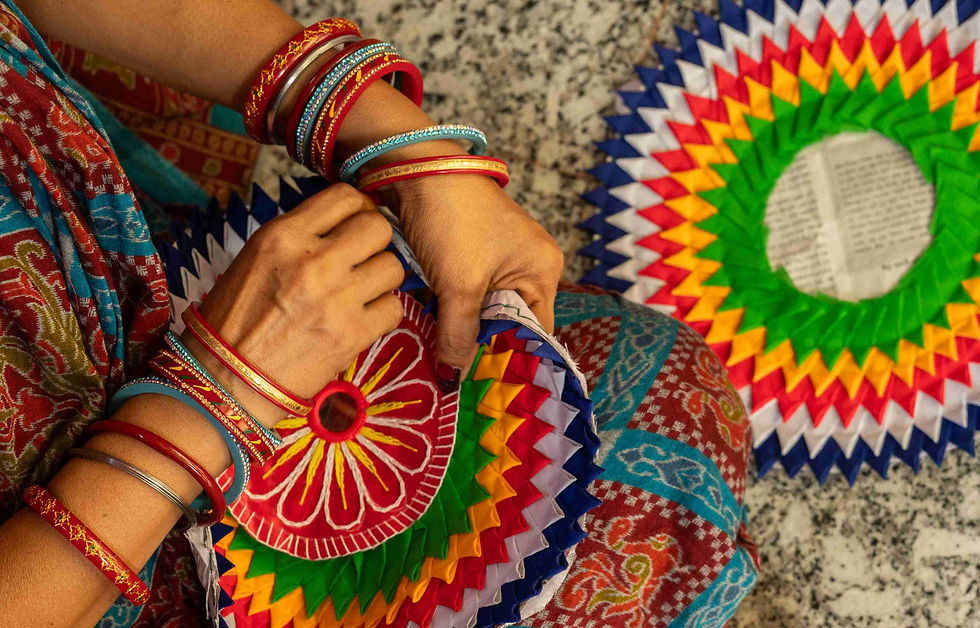
Observation methodology allows researchers to study this practical knowledge by paying close attention to the act of making. In the documentation of Chandua applique craft, OCO researchers observed how motifs are marked, cut and positioned; how Kongura strips create concentric structures; how stitches are applied; and how an appliqué canopy is assembled from its centre towards its periphery.

These details reveal the sequence of decisions and techniques involved in producing the finished object. They also help explain how individual elements work together to create a larger structure. Studying traditional craft techniques in this way makes it possible to understand different dimensions of craft knowledge that a finished object alone cannot communicate. By observing artisans at work, OCO examines not only what is made, but also how it is made and what knowledge the process requires.
4. Documentation: Recording How Craft Traditions Change
Photographs, field notes, interviews, drawings and process documentation help researchers compare techniques, motifs, materials and production methods across locations and generations. Such craft documentation provide a basis for examining how craft practices respond to changing circumstances.

The Chandua research, for example, traces changes from hand stitching and traditional design elements to the use of sewing machines, commercially available lace, synthetic materials and other contemporary adaptations. Such changes reflect shifting material availability, production requirements, consumer preferences and market conditions. They form part of the contemporary history of the craft.
Through the documentation of traditional crafts, OCO seeks to record Odisha crafts with both continuity and transformation without assuming that a tradition must remain unchanged to retain its significance. Documenting these adaptations helps build a more complete record of the craft as it exists across different periods and contexts.
5. Material Study: What Materials Reveal About a Craft
Materials carry histories of their own. Textiles, threads, mirrors, lace, bamboo, wood and embellishments are not merely components of an object. Their properties, availability, costs and uses can reveal changes in technology, production and relationships between artisans and markets.
OCO’s material study in craft research examines these elements closely to understand how objects are constructed and how material choices influence craft practices.
Let us look at the example of the study of the Chattri in Boudh district. Researchers documented its bamboo frames, wooden components, textile construction, stitching and knots, while also observing how artisans have incorporated power tools into the making process.Examining these elements helps researchers understand both the physical structure of the object and the techniques used to produce it. The use of tools and materials can also offer insights into how established practices adapt to changing working conditions.
Material study therefore adds another dimension to craft research methodology. The object becomes a source of evidence through which researchers can investigate construction techniques, technological developments and changing relationships with available resources.

6. Bringing it Together: How OCO Builds an Understanding of Craft
No single method can fully explain a living craft. Each reveals a different dimension of the knowledge surrounding it.
An artisan’s account may offer insights into a craft’s history. Observing the making process may reveal how a technique is practised today. Examining the object may raise new questions, while material evidence and archival records may provide additional perspectives. OCO brings these forms of evidence together to develop a more comprehensive understanding of Odisha’s traditional crafts.
This process also benefits from multidisciplinary perspectives. Researchers, artists, designers and curators may approach the same craft with different questions, drawing attention to its historical, material, technical and visual dimensions. These perspectives complement the knowledge of artisans, who remain central to understanding the practices being studied.
Through this approach, OCO moves beyond creating an inventory of objects or compiling isolated histories. It seeks to understand craft as a living system of knowledge shaped by people, place, memory, materials, labour, economy and time.
From Research to Public Knowledge: OCO’s Living Archive
Research becomes more meaningful when the knowledge it generates can be shared, revisited and understood by wider audiences.
OCO’s approach connects field-based research through its Residency and Fellowship programmes with exhibitions and research publications. Together, these provide different ways of interpreting and sharing the findings of craft research in Odisha. This contributes to a broader understanding of traditional crafts of Odisha and the communities that sustain them.
For OCO, building a living archive means recording more than objects or techniques. It means documenting the people, practices, materials and changing circumstances through which craft knowledge continues to exist.
Understanding Craft as a Living Practice
To study a craft is to pay attention to the knowledge embedded in its making, the histories carried through memory, the materials that shape its form and the communities that keep its practice alive.Through fieldwork, oral histories, observation, documentation and material study, Odisha Craft Odyssey seeks to create a deeper understanding of Odisha’s traditional crafts.
The purpose is not simply to preserve a record of what has been inherited, but to understand how that inheritance continues to evolve. By bringing together different forms of knowledge and evidence, OCO seeks to document craft as a living practice, connected to its past while continually responding to the present.
Comments